
Building a Digital Brand That People Remember
A brand is not just a logo.
It isn’t a color palette, a typeface, an Instagram feed, or a beautifully designed website.
Those things help people recognize a brand—but recognition alone isn’t enough.
The strongest brands create a feeling. They communicate something consistently enough that people begin to understand what the business represents, what they can expect from it, and why they should choose it.
That is where branding and marketing become connected.
Branding shapes perception.
Marketing creates visibility.
Content builds relationships.
And consistency turns those relationships into trust.
For me, building a digital brand isn’t about being everywhere or constantly promoting something.
It’s about creating a clear identity and showing up with enough purpose that people begin to remember it.
01. A Brand Starts With Clarity
Before thinking about logos, websites, advertisements, or social media, a business needs to understand itself.
What do you actually do?
Who do you help?
What makes your approach different?
How should someone feel after interacting with your brand?
Why should they remember you instead of someone else?
These questions sound simple, but they influence almost every decision that follows.
Without clarity, branding becomes decoration.
A company may have beautiful graphics and polished content while communicating a completely different message every week.
Strong branding begins when the business understands what it wants to represent.
Once that foundation exists, design and marketing have something meaningful to communicate.
02. Your Brand Is Bigger Than Your Logo
A logo is important.
It gives a business a recognizable visual signature.
But people rarely build trust with a company because they like its logo.
They build trust through repeated experiences.
The website feels professional.
The messaging is clear.
Social media content is useful.
Emails feel thoughtful.
Customer service is consistent.
The quality of the work matches what was promised.
All of these interactions contribute to the brand.
That means branding exists everywhere a customer encounters the business.
Logo. Website. Content. Communication. Service. Experience. Reputation.
Together, they create perception.
And perception is ultimately what a brand lives inside.
03. Consistency Creates Recognition
Imagine seeing a company use sophisticated minimal design on its website.
Then you open its social media account and everything is bright, playful, and completely unrelated.
Then its emails use another visual style and a different tone of voice.
Individually, each piece might look fine.
Together, they don’t feel like the same company.
Consistency connects those experiences.
That doesn’t mean every graphic needs to look identical.
It means the brand should have recognizable characteristics.
Typography.
Color.
Photography.
Language.
Layout.
Tone.
Messaging.
Even the way the business explains its services.
When those elements work together repeatedly, people begin recognizing the brand before they even see the logo.
That’s powerful.
04. Good Branding Creates a Feeling
Some brands feel premium.
Some feel approachable.
Some feel innovative.
Some feel established.
Some feel energetic.
Some feel calm.
These feelings don’t happen accidentally.
Visual design contributes to them, but so does language.
Compare:
“Contact us for more information.”
with:
“Tell us what you’re building.”
Both can lead to the same contact form.
But they create different personalities.
Small decisions like these accumulate across an entire digital experience.
Typography, photography, spacing, animation, copywriting, and interaction all influence how someone perceives the brand.
Good branding is therefore not simply about what a company says.
It is also about how the company makes people feel while saying it.
05. Your Website Is Often the Center of Your Digital Brand
Social platforms change.
Algorithms change.
Advertising campaigns come and go.
But for many businesses, the website remains the central place where the brand can fully control its story.
A website gives you room to communicate more than a social media profile ever can.
You can explain your services.
Show your work.
Tell your story.
Build credibility.
Publish useful content.
Answer questions.
Collect inquiries.
Create a complete visual experience.
This is why I see website development and branding as closely connected.
A website shouldn’t simply contain the brand’s logo and colors.
It should feel like the brand.
The layout, typography, interactions, imagery, content, and performance should all contribute to the same identity.
06. Content Should Provide Value Before Asking for Attention
A lot of marketing follows the same pattern:
Buy this.
Book this.
Contact us.
Get a quote.
Limited offer.
Schedule now.
Calls to action are necessary.
But if every interaction asks the audience for something, the relationship becomes one-sided.
Strong content gives something first.
Knowledge.
Ideas.
Inspiration.
Answers.
Perspective.
Entertainment.
Useful information.
A remodeling company might explain what homeowners should know before starting a kitchen renovation.
A designer might share how materials influence the feeling of a room.
A software company might explain how automation can reduce repetitive work.
A photographer might help clients prepare for a portrait session.
The content is still connected to the business.
But instead of simply saying “hire us,” it demonstrates expertise.
That builds a very different kind of relationship.
07. Education Builds Authority
People usually trust businesses that help them understand something.
This is especially important for services where customers may not fully understand the process.
Construction.
Software development.
Interior design.
Marketing.
Finance.
Professional photography.
Customers often arrive with questions.
How does this work?
How much should I expect?
What should I prepare?
What mistakes should I avoid?
How do I choose the right provider?
Brands that answer those questions consistently become useful.
And useful brands become memorable.
Educational content isn’t just an SEO strategy.
It is a way of demonstrating expertise before a customer ever speaks with you.
08. Storytelling Makes Information Human
Facts communicate.
Stories connect.
A company could say:
“We have 20 years of experience.”
That establishes credibility.
But telling the story of how the company began, what it learned, the challenges it solved, and why it approaches projects differently gives that experience meaning.
The same applies to projects.
Instead of simply showing a finished website, explain the challenge.
What did the client need?
What wasn’t working?
What approach did you take?
What changed after the project?
Now the portfolio becomes more than a gallery.
It becomes evidence of thinking.
Storytelling helps audiences understand not only what you created, but why it mattered.
09. Social Media Should Build Community, Not Just Reach
Follower counts are easy to focus on.
But a large audience isn’t necessarily an engaged audience.
A smaller community that genuinely pays attention can be much more valuable.
Good social media strategy therefore goes beyond publishing content frequently.
It asks:
What does this audience care about?
What questions do they have?
What kind of content do they save?
What do they share?
What starts conversations?
What gives them a reason to return?
The goal is not simply to appear in someone’s feed.
It is to gradually become a source they recognize and value.
That takes time.
But relationships usually do.
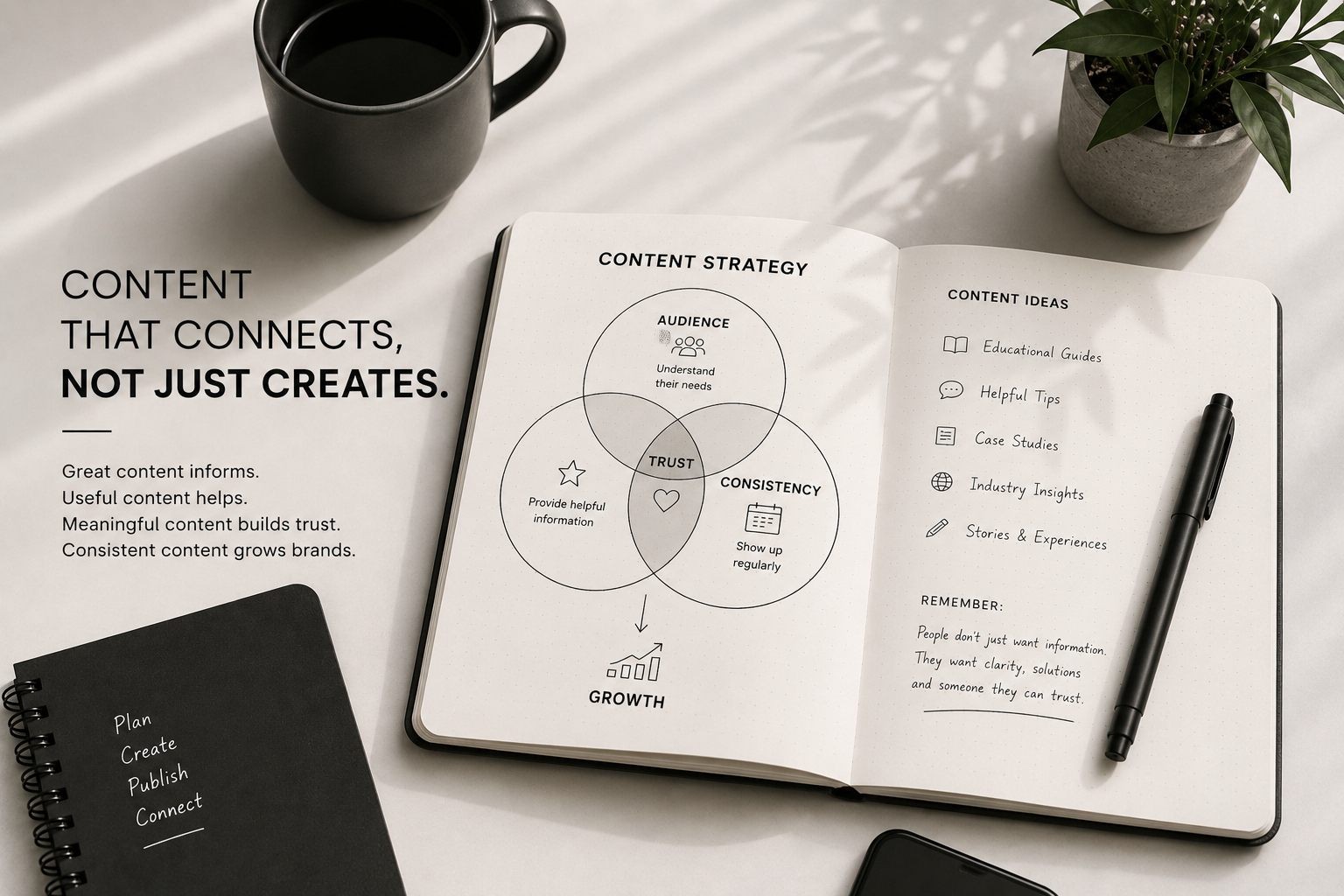
10. Content Needs a System
Creating content without a strategy can become exhausting.
Every week begins with the same question:
“What should we post?”
A content system makes the process much easier.
I like thinking about several recurring categories.
Educational Content
Teach something useful.
Helpful Tips
Solve small problems quickly.
Case Studies
Show how real problems were approached.
Industry Insights
Share observations and expertise.
Stories & Experiences
Make the brand more human.
Work & Results
Demonstrate what the business can actually deliver.
These categories provide structure without making every piece of content identical.
The brand always has something meaningful to talk about.
11. Trust Is Built Through Repetition
Trust rarely comes from one advertisement.
It develops through repeated positive interactions.
Someone discovers an article.
Later, they see a useful social post.
A few weeks later, they visit the website.
They explore several projects.
They read a testimonial.
Eventually, they need the service.
Which company comes to mind?
Often, it is the one that has already been providing value.
This is why consistent marketing can be so powerful.
Not every piece of content needs to generate an immediate sale.
Some content exists simply to create familiarity.
Visibility creates recognition.
Recognition creates familiarity.
Familiarity can create trust.
And trust makes future decisions easier.
12. Design and Content Need Each Other
Great content presented poorly can lose attention.
Beautiful design without meaningful content can feel empty.
The strongest digital brands combine both.
Design makes information easier and more enjoyable to consume.
Content gives the design something worth communicating.
This applies everywhere.
A blog.
A social media post.
A landing page.
A portfolio.
A case study.
An email campaign.
The visual system and the message should support each other.
When they do, the experience feels intentional rather than assembled.
13. Marketing Should Feel Like the Brand
Sometimes marketing becomes disconnected from branding.
A premium brand builds an elegant website and carefully considered identity, then launches aggressive advertisements that feel completely unrelated.
That inconsistency can weaken perception.
Marketing should extend the brand rather than temporarily replace it.
The same voice.
The same values.
The same level of visual quality.
The same understanding of the audience.
A person should be able to move from an advertisement to a website to an email and feel like they are still interacting with the same company.
That continuity creates confidence.
14. People Remember Distinctive Brands
There is a temptation in digital design to copy what already works.
A competitor uses a particular layout.
Another brand uses certain language.
A popular website introduces an animation style.
Soon, everyone begins looking similar.
Following established patterns can improve usability, but branding also needs character.
What makes this company feel different?
Maybe it is the typography.
Maybe it is photography.
Maybe it is a particular writing style.
Maybe it is the way projects are presented.
Maybe it is an unusual interaction.
Maybe it is simply an exceptionally clear point of view.
Distinctiveness doesn’t require being strange.
Sometimes it means taking familiar elements and combining them in a way that feels uniquely yours.
15. Analytics Should Inform Marketing Without Controlling Creativity
Marketing should be measurable.
We should understand which content receives attention, which channels produce inquiries, where traffic originates, and what contributes to conversions.
But numbers shouldn’t remove creativity from the process.
Not every valuable piece of content will immediately produce measurable revenue.
Some strengthen brand perception.
Some educate.
Some create trust.
Some introduce an idea that influences a customer months later.
Data should help answer questions.
What topics resonate?
Which channels attract the right audience?
What content generates meaningful engagement?
What leads to inquiries?
Then strategy can evolve.
The goal is not to allow analytics to make every creative decision.
It is to use data to make creativity more informed.
16. AI Can Support Content Without Replacing Perspective
AI has dramatically changed content creation.
It can help brainstorm ideas, organize research, create outlines, repurpose information, analyze performance, and speed up repetitive parts of marketing.
That can be incredibly useful.
But brands still need perspective.
If every company asks the same AI tools to generate the same generic content, everything begins sounding identical.
Technology should help communicate your thinking—not replace the need to have something worth saying.
The strongest content still needs:
Experience.
Opinion.
Knowledge.
Examples.
Stories.
Personality.
A real understanding of the audience.
AI can accelerate the process.
The brand still needs to provide the point of view.
17. Brand Building Takes Time
There is no single post that creates a brand.
No logo automatically creates trust.
No advertising campaign permanently establishes reputation.
Branding happens gradually.
Every project contributes.
Every interaction contributes.
Every piece of content contributes.
Every customer experience contributes.
That can make brand building feel slow.
But it is also what makes a strong brand difficult to copy.
Competitors can copy a color.
They can copy a layout.
They can offer similar services.
They cannot easily copy years of consistent experiences, relationships, expertise, and reputation.
That becomes the real brand.
A Simple Content Philosophy
When thinking about content and digital marketing, I like a straightforward framework:
Understand your audience.
Know what they care about.
Provide something useful.
Teach, explain, inspire, or solve.
Communicate consistently.
Don’t disappear until you need to sell something.
Create with purpose.
Every piece of content should have a reason to exist.
Build trust over time.
Allow relationships to develop naturally.
And then repeat.
Plan → Create → Publish → Connect → Learn → Improve
Consistency compounds.
What I Look for in a Strong Digital Brand
A strong digital brand doesn’t necessarily need to be loud.
But it should be clear.
Identity — Is the brand visually recognizable?
Positioning — Is it clear what the business does and who it serves?
Consistency — Does the experience feel connected across platforms?
Value — Does the brand provide something useful beyond promotion?
Personality — Does the communication sound human and distinctive?
Credibility — Is there evidence behind the claims?
Experience — Does interacting with the brand feel thoughtful?
Trust — Does everything consistently support what the company promises?
When those pieces work together, marketing becomes much more than promotion.
It becomes reputation building.
Final Thoughts
People don’t build relationships with logos.
They build relationships with experiences, ideas, stories, and people.
A strong digital brand understands that.
It doesn’t simply appear when it has something to sell. It teaches. It communicates. It shows its work. It shares useful ideas. It develops a recognizable voice and consistently delivers on what it promises.
Over time, something important happens.
People begin to recognize it.
Then they remember it.
Eventually, they trust it.
That’s the kind of digital branding I believe matters most:
Create with purpose. Provide real value. Tell meaningful stories. Stay consistent. Build trust.
Because the strongest brands don’t simply capture attention.
They give people a reason to come back.